She looked at the folder between them.
Then she looked at him.
“Do you know what I remember most about yesterday?”
Ryan shook his head.
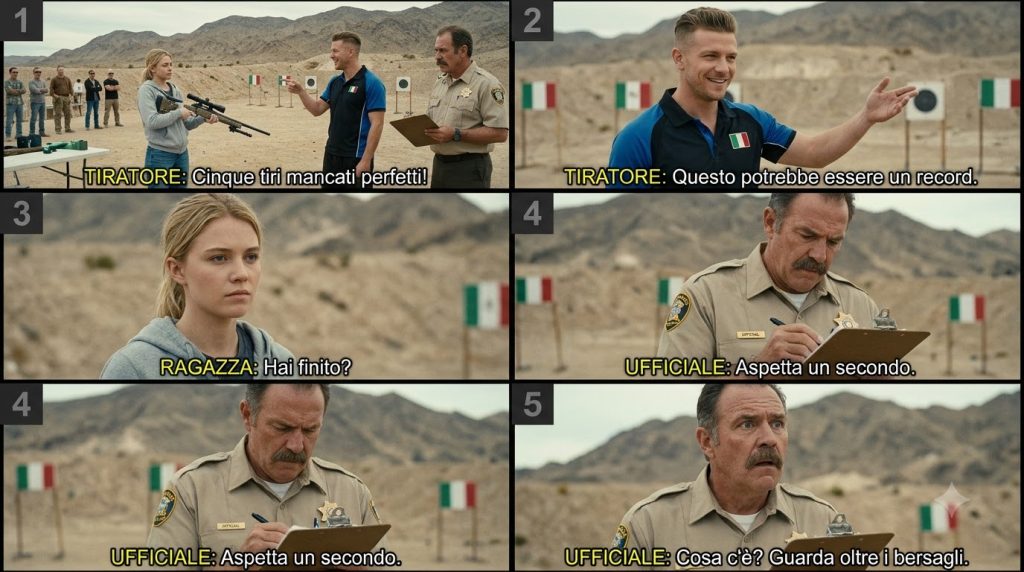
“The first shot.”
He frowned.
“Not the fifth?”
“No.”
She rubbed her thumb against the side of her index finger.
“The first shot was when I realized that the result might happen exactly as I expected.
The display would show a miss, and people would decide what that meant before anyone examined the records.”
She paused.
“I thought I was prepared for it.
I told myself I didn’t care what strangers thought.
I told myself that if the evidence survived, none of the rest would matter.”
Her voice became quieter.
“But when everyone laughed, I could hear my father in my head.
Not the things he said about the system.
The ordinary things.”
Ryan remained still.
“He used to tell me to keep my hands warm in the winter.
He used to complain when I forgot to eat lunch.
He would have hated that I stood there letting people treat me like a joke.”
She looked down.
“And I couldn’t tell him that I was trying to finish what he started.”
Ryan’s face had changed.
He looked as though he wanted to speak, but he did not interrupt.
Claire took a slow breath.
“You made me feel like his work was a joke too.”
Ryan closed his eyes.
For several seconds, neither of them moved.
When he opened them, they were wet.
“I didn’t know,” he whispered.
Claire nodded once.
“I know.”
He looked at her, confused.
“You know?”
“I believe you didn’t know about all of it.
But that isn’t the same as saying you couldn’t have done better.”
Ryan lowered his head.
She continued.
“You don’t need to understand my father’s life to treat me like a person.
You don’t need to know my history to ask whether something is fair.
You only needed to stop laughing long enough to consider that the scoreboard might not tell the whole story.”
He pressed his lips together.
“I understand.”
“No,” Claire said gently.
“You understand what happened.
Whether you understand what you did is something you’ll have to prove over time.”
Ryan nodded.
It was the first time in years that someone had told him his apology was not the end of the matter.
He found that he had no argument against it.
Claire stood.
Ryan rose too, but he did not reach for her hand.
“Thank you for hearing me,” he said.
She paused at the door.
“I heard you.”
Then she left.
Ryan remained in the room long after the door closed.
He had come hoping for forgiveness.
He left with something less comfortable and perhaps more useful.
The knowledge that he had finally been heard, and that being heard did not entitle him to be absolved.
***
The championship board met with Claire the following week.
The room was the same one in which Ryan had protested the investigation.
This time, the atmosphere was different.
The blinds were open.
Sunlight fell across the conference table.
A vase of desert flowers stood near the window, and a framed photograph of the original competition range had been removed from the wall.
Eleanor Shaw sat at the head of the table.
Nathan sat beside her.
Samuel was present, along with representatives of the independent audit team.
Claire took the seat nearest the door.
Eleanor began.
“Miss Bennett, the board has reviewed the independent findings concerning your father’s work.
We acknowledge that the previous report attributed misconduct to him without adequate verification.
That conclusion was not supported by the evidence available to the review, and the organization failed to provide him with a fair opportunity to challenge it.”
Claire listened without moving.
Eleanor continued.
“We withdraw that conclusion and issue a formal correction.
We also acknowledge that our internal procedures failed to preserve the independence of the technical review.”
She opened a document.
“The board would like to recognize Daniel Bennett’s contribution to the development of the championship’s validation procedures.
We propose establishing an annual technical integrity award in his name, together with a public archive of the corrected findings.”
For a moment, Claire could not speak.
She had imagined a plaque.
She had imagined a press conference.
She had imagined a room full of people finally saying her father’s name without embarrassment.
But the words were more complicated than she expected.
An award could honor him.
It could also become a way for the organization to congratulate itself for correcting a mistake it should never have made.
She looked at Eleanor.
“Will the archive include the original report?”
“Yes.”
“The signatures?”
“Where legally permissible, yes.”
“The evidence that contradicted it?”
“All relevant findings will be included.”
“Will the championship publish the failures in its own review process, not just the failures of individual employees?”
Eleanor paused.
Then she nodded.
“Yes.”
Claire took a breath.
“Then I support the archive.”
She glanced toward Samuel.
“But I don’t want the award to become a story about how the championship saved my father’s reputation.
He didn’t need the championship to make him honest.
He was honest before anyone here decided to listen.”
Eleanor lowered her eyes.
“You’re right.”
Claire looked around the table.
“I want the award to recognize the work he did.
And I want the rules to change so that the next person who finds something wrong doesn’t have to spend years fighting alone.”
The independent auditor nodded.
“That is consistent with our recommendations.”
“Then that’s what I want.”
Eleanor closed the document.
“We will proceed on that basis.”
The meeting ended without applause.
Claire was grateful.
As she gathered her papers, Samuel approached her.
“Your father would have been proud of you.”
She stopped.
For a moment, the old pain returned so sharply that she could barely look at him.
“Maybe,” she said.
Samuel’s expression softened.
“I shouldn’t presume to know.”
“No,” she replied.
“You shouldn’t.”
He nodded.