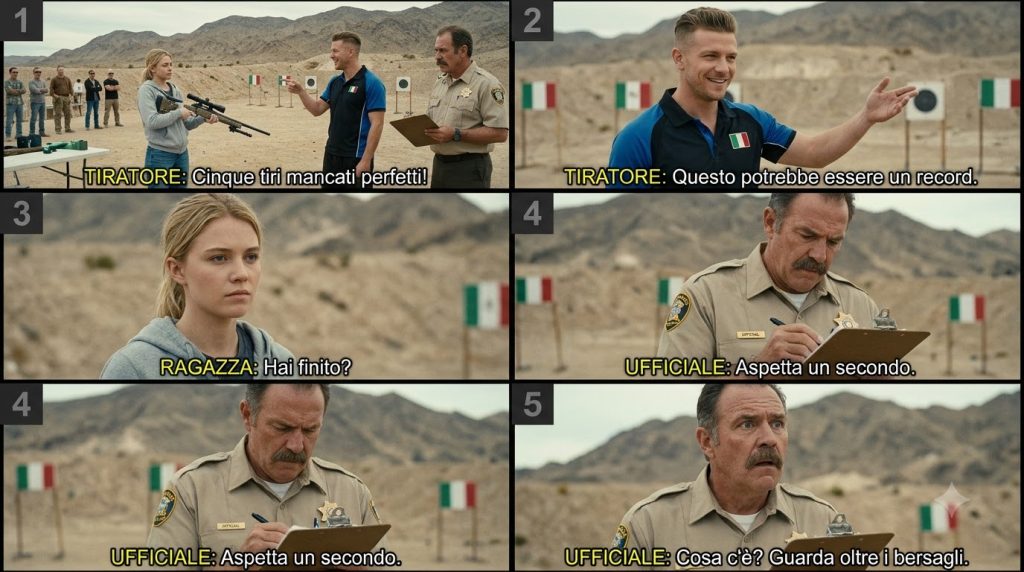
Now he wondered how many times he had mistaken a clean-looking scoreboard for a clean competition.
***
Claire did not sleep that night.
She sat at her kitchen table with the lights off, watching the headlights of passing cars move across the ceiling.
Her father’s old workshop stood behind the house.
The building had a corrugated metal roof, a narrow window, and a door that stuck whenever the weather turned dry.
A single bulb remained lit above the workbench.
She had never found the courage to clear the room.
His coffee mug was still on the shelf.
His reading glasses were still beside a box of screws.
On the workbench lay a small brass nameplate he had intended to attach to a piece of equipment.
DANIEL BENNETT.
Below the name, he had engraved three words.
VERIFY THE RECORD.
Claire had found it six months after his death.
She had sat on the workshop floor holding it in both hands until the sun went down.
Now she walked across the yard and opened the door.
The familiar smell of metal, dust, and old machine oil rose around her.
She turned on the light.
Her father’s chair stood beneath the workbench, slightly angled as if he had just pushed himself away to retrieve a tool.
Claire rested her hand on its back.
For a moment, she imagined him looking up from his notes.
“Long day?” he would have asked.
She almost laughed.
Then her throat tightened.
“I did what you told me,” she whispered.
The room offered no answer.
She lowered herself into the chair and opened the bottom drawer.
Inside lay two encrypted drives, several notebooks, and a thick envelope containing copies of the correspondence her father had sent to the championship.
She took out the first notebook.
His handwriting was neat and compact.
Dates appeared in the margins.
Technical observations were underlined.
Several pages contained diagrams of sensor channels and notes about unexplained configuration changes.
On the final page, written only a few weeks before his death, was a sentence that made her stop breathing for a moment.
If they ever examine the original data independently, the records will speak.
Beneath it, in smaller letters, he had written:
I only hope Claire never has to carry this.
She pressed the notebook against her chest.
For years, she had thought that proving her father right would free her from the burden he had left behind.
Now she understood that the truth could not bring him home.
It could only answer the question that had followed her into every quiet room.
Had he imagined it?
Had grief and exhaustion made him see patterns where none existed?
Had the people who dismissed him been right?
She closed her eyes.
“I believed you,” she whispered.
Then, after a long silence, she added, “I’m sorry I couldn’t help you sooner.”
She remained in the chair until dawn began to pale the window.
When the first sunlight touched the workbench, she placed the notebook in an evidence folder and locked the drives in a small metal case.
For the first time in two years, she allowed herself to leave the workshop without looking back.
***
At 8:30 the following morning, the championship board convened an emergency meeting.
Ryan Mercer arrived wearing a dark suit and a championship pin.
He had shaved carefully.
His hair was neatly styled, and he carried a leather folder beneath one arm.
To an observer who knew nothing about the previous day, he looked like a man attending an ordinary business meeting.
Only his hands betrayed him.
He kept smoothing the edge of his folder.
The board’s chairperson, Eleanor Shaw, sat at the head of a long conference table.
Nathan occupied a seat near the window.
Samuel sat opposite him, with the compliance officer beside him.
Ryan took his place.
“Before we begin,” he said, “I want to make it clear that I consider yesterday’s treatment of me unacceptable.”
Eleanor folded her hands.
“You will have an opportunity to respond to the findings.”
“Good.
Because I will not allow an unfounded accusation to destroy my reputation.”
Nathan looked at him.
“No one has made a formal accusation against you.”
“Then why was my name dragged into a public investigation?”
“Because you were involved in the event under examination.”
Ryan’s jaw tightened.
“I was involved because I agreed to give an inexperienced woman a chance to compete.”
Eleanor glanced at the folder in front of her.
“Mr.
Mercer, did you know Claire Bennett before yesterday?”
“No.”
“Had you reviewed her competition history?”
“She had no recognized history.”
“Did you know her father?”
Ryan’s fingers stopped moving.
“No.”
The answer came a little too quickly.
Nathan noticed.
So did Eleanor.
She made a note.
“Very well.
We will proceed with the technical findings.”
The independent examiner’s preliminary report appeared on the conference screen.
It did not establish who had altered the configuration.
It did not yet explain every discrepancy.
It did, however, confirm that the five public scores could not be treated as reliable evidence of Claire’s performance.
The event’s configuration had been inconsistent with the raw records.
The championship’s internal procedures had failed to detect the discrepancy before the challenge.
And the same type of inconsistency appeared in earlier competitions.
Eleanor removed her glasses.
“This is a serious failure.”
Ryan leaned forward.
“Then fix the system.
Why are we discussing me?”
“Because you publicly declared the results conclusive before the chief referee had completed his review.”
“I was reading the scoreboard.”
“You were mocking another competitor.”
“She accepted the challenge.”
Nathan’s voice was low.
“That does not give you the right to turn an unverified score into a public humiliation.”
Ryan looked at him with open resentment.
“You expect me to apologize for winning?”
“No,” Nathan replied.
“I expect you to understand the difference between winning and using your position to make someone else look small.”
Ryan stared at him.
For several seconds, the room remained silent.
Then Ryan laughed.