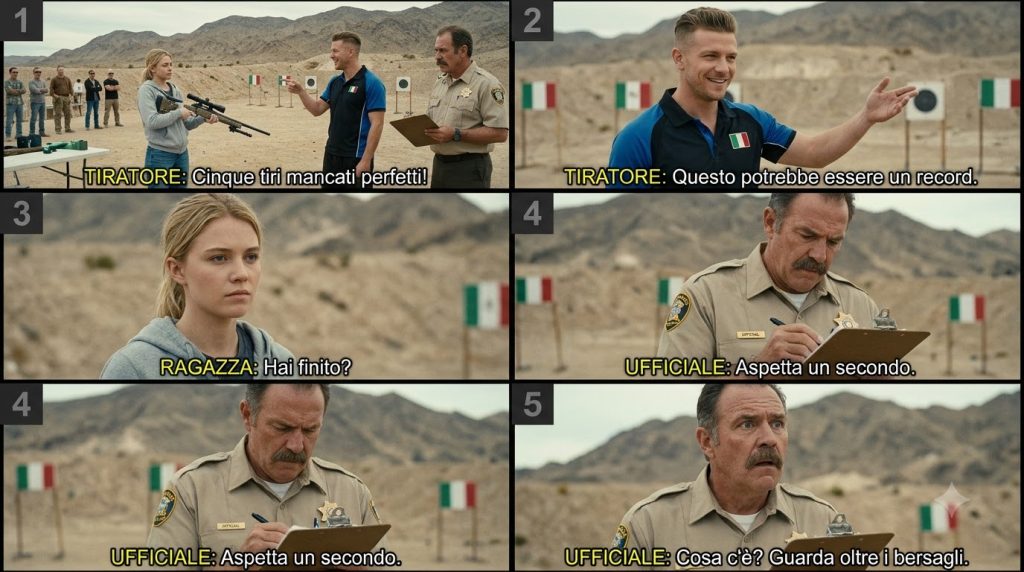
“Do it.”
Ryan’s voice rose.
“This is getting ridiculous.”
The compliance officer turned toward him.
“Mr.
Mercer, you have been asked to remain available.
You have not been accused of a violation, but you are not authorized to interfere with this examination.”
“I am the reigning national champion.”
“And I am the compliance officer responsible for this event.”
She spoke without anger.
That seemed to infuriate him more.
Ryan looked toward the crowd as if expecting them to intervene on his behalf.
A few people avoided his eyes.
Others watched him with an interest that was beginning to resemble suspicion.
He turned back to Nathan.
“Fine.
Examine everything.
But when this is over, I want a public apology.”
Nathan closed the folder.
“If the evidence shows that you were wronged, you’ll receive one.”
“And if it doesn’t?”
“Then the evidence will speak for itself.”
Ryan’s nostrils flared.
He walked away before anyone could answer.
For several seconds, the only sound near the bench was the low electrical hum of the scoring equipment.
Then Samuel approached Claire.
“Miss Bennett, may I ask how you knew?”
She looked at the tablet in his hands.
“I didn’t know for certain.”
“But you expected this result.”
“I expected the records to disagree with the display.”
Samuel frowned.
“Why?”
Claire’s gaze drifted toward the desert.
“Because the person who changed the configuration assumed nobody would question an empty score.”
She paused.
“And because my father spent four years telling people that the system was lying.”
Samuel’s grip tightened around the tablet.
“What was your father’s name?”
“Daniel Bennett.”
Something moved across his face.
Recognition.
Then something else.
Regret.
He lowered his eyes.
“I knew Daniel.”
Claire’s breathing changed.
“You knew him?”
Samuel nodded slowly.
“I worked with him on the original scoring system.
Before the championship upgraded its equipment, he helped design the validation process.
He was the reason we could distinguish between a sensor failure and a genuine miss.”
Claire looked at him as if he had suddenly begun speaking another language.
“My father never told me he worked here.”
“He left before you were old enough to understand what happened.”
“What happened?”
Samuel opened his mouth, then closed it again.
He glanced at Nathan.
The chief referee had been watching them.
“Miss Bennett,” Nathan said gently, “we should have this conversation somewhere private.”
Claire looked at the crowd.
Thousands of people were still watching.
Some were curious.
Some were skeptical.
A few had begun filming her again.
She pulled the sleeves of her hoodie over her hands.
“I don’t want another room full of people telling me what happened to my father.”
Nathan’s expression softened.
“Then we’ll find a quiet room, and nobody will tell you anything until we have evidence.”
She studied him for a moment.
Finally, she nodded.
***
The room behind the technical enclosure was small and cold.
An air conditioner rattled above a metal cabinet.
Fluorescent lights cast a pale glow across a scratched table, and the smell of burnt coffee lingered in the corners.
Nathan asked the others to wait outside.
Only Samuel, the compliance officer, and Claire remained.
Claire sat nearest the door.
She had not removed her hoodie.
Nathan placed a glass of water in front of her.
She looked at it but did not touch it.
“Before we discuss your father,” he said, “I want you to know that nothing we have discovered so far proves misconduct by any individual.”
“I understand.”
“And I want to be clear about something else.
Whatever happened here, you are entitled to a fair examination of the evidence.”
Claire’s eyes remained on the glass.
“That’s what my father wanted.”
Nathan sat opposite her.
“What happened to him?”
For a long moment, she did not answer.
Outside, a vehicle passed over the service road.
Its tires crunched against gravel, then faded into the distance.
“My father was an engineer,” she began.
“He worked on electronic scoring systems, sensor validation, and equipment audits.
He wasn’t a famous competitor.
He didn’t have trophies.
Most people didn’t know his name.”
She rubbed her thumb against a loose thread on her sleeve.
“But he could look at a machine for ten minutes and tell you what everyone else had missed.”
Samuel listened without interrupting.
“Four years ago, he discovered that several competition results had been altered after the original sensor data was recorded.
At first, he thought it was a software problem.
He spent weeks checking the logs.
Then he found that the discrepancies kept appearing around the same maintenance windows.”
Nathan leaned forward.
“Did he report it?”
“Three times.”
“To whom?”
“The tournament’s technical department.
The independent oversight committee.
And the board.”
“What happened?”
Claire looked up.
“They told him he was mistaken.”
Samuel closed his eyes briefly.
She noticed.
“He showed them the raw records,” she continued.
“He explained the difference between what the sensors recorded and what the public display showed.
He asked them to preserve the logs and commission an independent audit.”
“And they refused?”
“They said his conclusions were unsupported.
Then they accused him of accessing records outside his authorization.”
The compliance officer’s expression hardened.
“Was there an investigation?”
“There was an internal review.
They concluded that my father had misunderstood the system and that his conduct had damaged confidence in the championship.”
Claire swallowed.
“He lost his contract.
Other companies stopped hiring him.
People he had worked with for years stopped answering his calls.”
Samuel stared at the tabletop.
“I remember the announcement,” he said quietly.
Claire turned toward him.
“You remember it?”
“Yes.”
“You were there?”
“I was a technical supervisor then.
I read the report.”
“And you believed it?”
The question was not loud.
It was worse than loud.
Samuel took a slow breath.
“At the time, I accepted the conclusion.
I shouldn’t have.”
Claire looked away.
“Did you ever speak to him?”
“No.”
“Did you ever ask him to show you the evidence?”
Samuel did not answer.
His silence was enough.