Claire’s shoulders rose with a breath that seemed to catch halfway.
“My father used to check his phone every morning.
For months, he thought someone would call and admit they’d made a mistake.”
She pressed her lips together.
“He kept a clean shirt hanging in the workshop in case he had to attend a meeting.
Even after the contract was gone.
Even after the lawyers stopped replying.”
Her fingers tightened around the sleeve.
“I asked him why he didn’t stop trying.
He said that if he stopped, everyone would remember the accusation and forget the evidence.”
She looked at Samuel again.
“He died believing that people he trusted had decided his reputation was worth less than their convenience.”
Nobody spoke.
The air conditioner rattled overhead.
Nathan lowered his eyes.
“How did he die?”
Claire stared at the glass.
“A heart attack.
Two years ago.”
She paused.
“He was in the workshop.
I found him when I came home.”
Her voice remained steady until the final sentence.
Then it broke.
Only slightly.
She turned her face away at once, embarrassed by the sound.
Nathan did not reach for her.
He did not tell her to calm down.
He simply remained where he was, allowing the silence to exist without demanding that she fill it.
After a while, Claire wiped her cheek with the back of her hand.
“I don’t know if the stress caused anything,” she said.
“I’m not claiming that.
The doctors couldn’t tell me why it happened.
But he spent his last years trying to prove that he hadn’t lied, and he never got to see anyone take him seriously.”
Samuel removed his glasses.
He held them in both hands, staring at the lenses.
“I am sorry,” he whispered.
Claire looked at him.
“Did you say that to him?”
Samuel’s mouth trembled.
“No.”
“Then please don’t say it to me as if that fixes anything.”
He lowered his head.
“You’re right.”
For a moment, she seemed almost startled by the answer.
She had expected an explanation.
A defense.
A reminder that Samuel had been following procedures or that the evidence had not been clear.
Instead, he sat with his regret.
It did not restore her father.
But it was the first honest thing she had heard from someone connected to the championship in years.
Nathan opened the folder.
“Do you have copies of your father’s findings?”
Claire nodded.
“Some.
Not everything.”
“Where are they?”
“At home.
On two encrypted drives.
I also have printed reports, handwritten notes, and the correspondence he kept.”
“Can we obtain them through a formal evidence process?”
“Yes.”
She hesitated.
“But I want one condition.”
Nathan waited.
“I want the original records preserved before anyone begins comparing them with my father’s work.
I don’t want someone claiming that the data was planted because I had access to it.”
Nathan nodded.
“That is reasonable.”
“And I want the audit to be independent.
Nobody employed by the championship should be the only person deciding what the championship’s own system means.”
The compliance officer made a note.
“We can arrange that.”
Claire looked between them.
“And I want the names of everyone who signed the report accusing my father of misconduct.”
Nathan’s face became grave.
“If those names are part of the relevant records, they will be included in the investigation.”
She held his gaze.
“That’s all I’m asking.”
For the first time since she entered the stadium, her hands began to shake.
She placed them beneath the table.
Nobody mentioned it.
***
The independent examination began that evening.
By sunset, the stadium had emptied of most spectators.
The stands became long bands of shadow, and the electronic scoreboard remained dark against the fading orange sky.
Technicians sealed the relevant equipment.
Every cable connection was photographed.
Every accessible configuration file was copied through a documented procedure.
The original storage media were preserved, and separate working copies were created for examination.
Nathan remained in the technical enclosure until nearly midnight.
He watched the technicians compare the event records with the system’s configuration history.
At 9:42 p.m., one of them called him over.
“Chief, we have a discrepancy.”
Nathan approached the monitor.
“What kind?”
The technician pointed to a sequence of records.
“The public display was using one target assignment.
The raw event records reference another set of sensor channels.
The mismatch begins before the challenge.”
“How long before?”
“Approximately six hours.”
Nathan leaned closer.
“Can you determine whether it was an accidental configuration error?”
“Not yet.
But the change was made through an authorized administrative account.”
“Whose account?”
The technician hesitated.
“We’re still validating the access logs.
The account belongs to the tournament’s technical administration.”
Nathan stared at the screen.
“Preserve that record.”
“Already done.”
“And check whether the same configuration change occurred during earlier events.”
The technician nodded.
“We’re looking.”
Nathan straightened.
For the first time that day, the possibility of an innocent explanation felt smaller than the possibility of something deliberate.
But he had been a referee for twenty-seven years.
He knew that suspicion was not proof.
He also knew that the absence of proof was not permission to look away.
At 11:18 p.m., the first comparison report arrived.
Three earlier competitions showed discrepancies between archived raw records and published results.
Two had involved athletes who later lost their rankings after internal reviews.
The third involved a competitor who had withdrawn from the championship circuit after being accused of equipment tampering.
Nathan read the names twice.
One belonged to a young woman from Colorado who had been publicly disqualified three years earlier.
The other belonged to a veteran competitor who had spent decades building a reputation for fairness.
Neither had been given access to the original technical records.
Nathan set the report down.
He thought of Claire sitting in the cold room, trying not to cry.
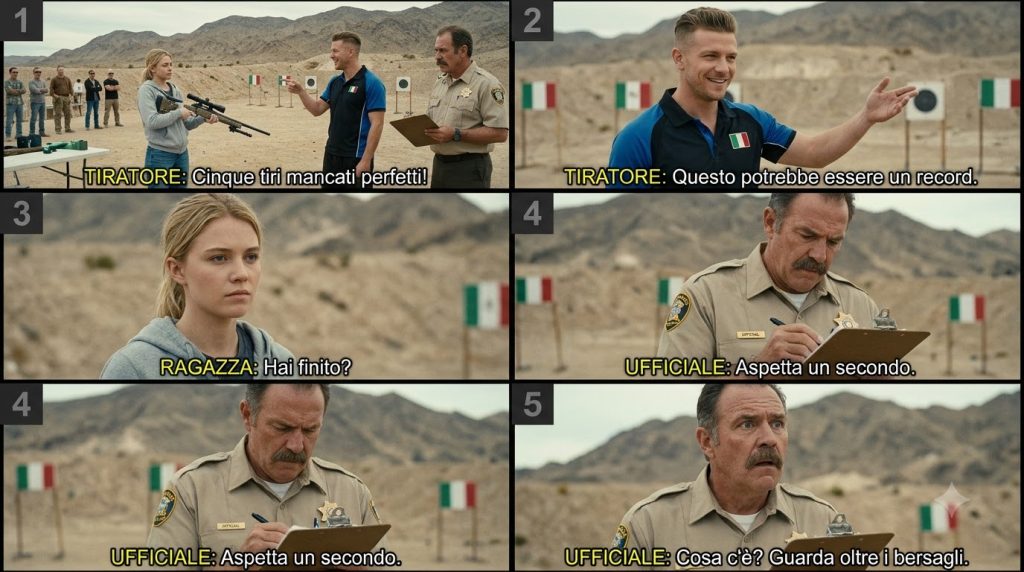
Then he thought of the thousands of people who had laughed when Ryan announced five perfect misses.
He had spent his career believing that the rules were only as trustworthy as the people enforcing them.