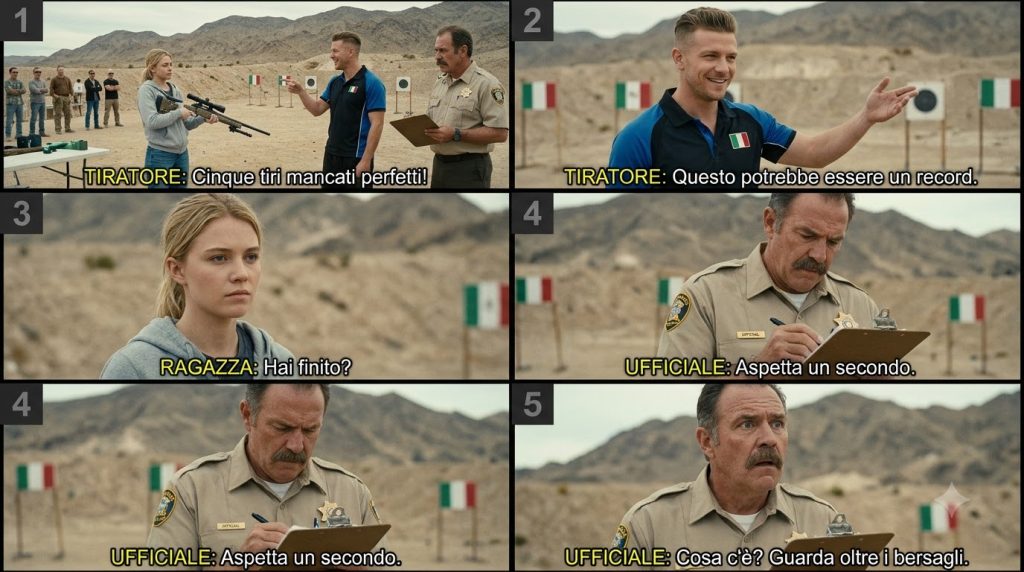
Then, after a moment, she added, “But I think he would have liked that the evidence survived.”
Samuel smiled faintly.
“I think he would have too.”
***
Three months later, the Arizona National Precision Shooting Championship reopened under new oversight procedures.
The changes were practical rather than theatrical.
Independent auditors now reviewed configuration changes.
Raw sensor records were preserved separately from public scoring outputs.
Access logs were protected against routine administrative deletion.
Competitors were given a clear process for challenging questionable results.
The championship also published the corrected report concerning Daniel Bennett.
His name appeared in the archive beside the work he had done.
Not as a legend.
Not as a symbol of perfect virtue.
As an engineer whose technical concerns had been inadequately investigated, whose reputation had been damaged by an unsupported conclusion, and whose work had contributed to safeguards that the championship had failed to maintain.
Claire read the report at home.
She printed the final page and carried it to the workshop.
The afternoon was warm.
A soft wind moved through the dry grass, and the distant mountains appeared pale blue beneath the sky.
She placed the page beside the brass nameplate.
Then she took a clean cloth and wiped the dust from the workbench.
It was the first time she had cleaned the room without feeling that she was erasing something.
She returned the notebooks to their drawer.
She placed the old coffee mug in the sink.
She folded her father’s work jacket and laid it on the chair.
For a moment, she stood in the doorway, looking at the room.
It was still his workshop.
It always would be.
But it no longer felt like a place where she had to wait for the past to answer her.
She turned off the light and stepped outside.
***
Ryan Mercer returned to competition the following season.
He did not return as the unchallenged face of the championship.
His sponsorship arrangements had changed.
His promotional appearances were fewer.
Several competitors who had once laughed at his jokes no longer sought his company.
He had lost something that could not be measured in points.
The effortless trust of people who had assumed that his confidence meant he was right.
At first, he resented it.
He caught himself blaming Claire for the attention, the investigation, the public criticism.
He imagined how different things might have been if she had simply accepted the five scores and left.
Each time the thought appeared, he remembered the room where she had told him about her father.
He remembered the way she had folded her hands in her lap to keep them from shaking.
And he remembered that she had not asked him to destroy his career.
She had asked him to stop treating a person like a joke.
That was harder to argue with.
He began attending the championship’s new technical briefings, not because anyone required him to speak, but because he wanted to understand how the system worked.
He asked questions.
Some were basic.
Some revealed that he had spent years trusting procedures he had never bothered to examine.
He listened when the technicians answered.
He did not turn every explanation into a performance.
The first time he challenged an official result, he did so privately and respectfully, providing the evidence he had noticed rather than announcing that someone had made a mistake.
The result was reviewed.
The original score stood.
Ryan accepted it.
Nobody applauded.
He found that he preferred it that way.
***
On the morning of the next championship, Nathan Cole stood near the entrance to the range.
The desert was cool before sunrise.
A thin layer of mist hovered above the distant ground, and the first light touched the metal railings.
He watched the technicians test the electronic targets.
Each test was logged.
Each configuration was checked.
A second examiner verified the records before the public display was activated.
The process took longer than it had in previous years.
Nobody complained.
Nathan carried a small notebook in his pocket.
On the first page, he had written a reminder.
A score is a record, not a verdict.
He had written it after reading Daniel Bennett’s final notes.
He did not know whether the sentence would become a permanent part of the championship’s procedures.
But he knew he would remember it.
A vehicle stopped near the entrance.
Claire stepped out.
She wore dark jeans, white sneakers, and the same oversized gray hoodie.
For a moment, Nathan was transported back to the previous year, to the laughter, the empty scores, and the terrible quiet that had followed.
Then Claire smiled.
It was not a large smile.
It did not erase anything.
But it reached her eyes.
“Morning, Chief.”
Nathan returned it.
“Morning, Claire.”
She looked toward the firing line.
“Everything working?”
“So far.”
“Good.”
He hesitated.
“Would you like to see the new verification process?”
She considered the question.
Then she nodded.
They walked together toward the technical enclosure.
Nathan explained the independent review steps.
Claire asked about the separation between raw records and public outputs.
She asked how access permissions were recorded, how discrepancies were escalated, and how an athlete could request a review without risking immediate public accusations.
Nathan answered each question.
When he did not know something, he said so.
Claire noticed.
It mattered more than he realized.
At the end of the briefing, she stood quietly beside the equipment.
“It’s better,” she said.
Nathan looked at the technicians.
“It should have been better before.”
“Yes.”
He waited.
She turned toward him.
“Thank you for listening when you did.”
Nathan shook his head.
“I should have listened sooner.”
“Yes,” she said again.
Neither tried to soften the truth.
Then Claire placed a hand briefly on his arm.
“But you did listen.”
Nathan looked down at her hand.
When she withdrew it, he felt the gesture as something more meaningful than an easy absolution.
It was a recognition that a person could acknowledge a failure without pretending it had never happened.