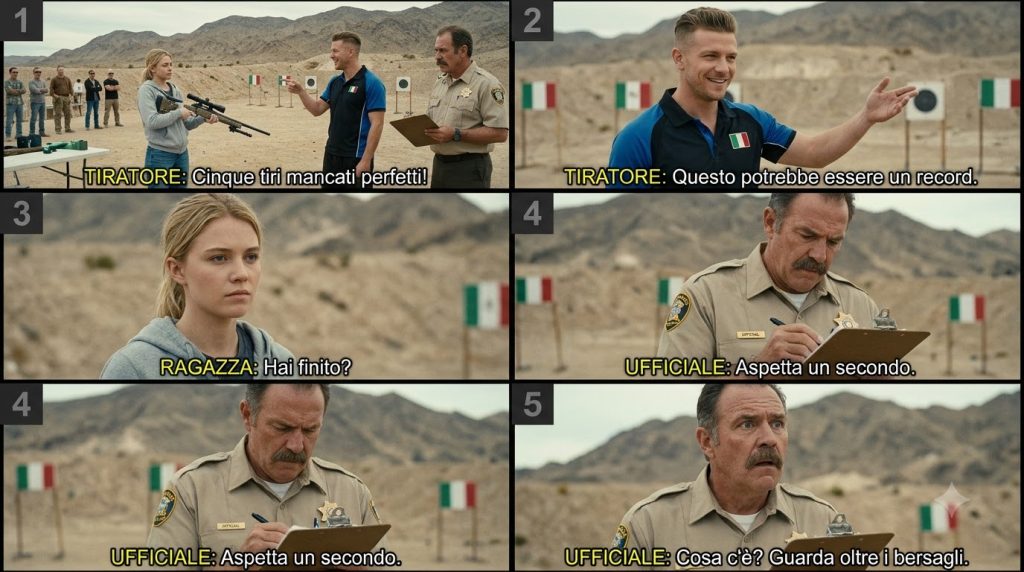
The first event started.
The targets illuminated.
The competitors took their positions.
A shot rang out across the range.
The electronic system registered the result, and the public display updated.
An independent examiner checked the corresponding record.
Everything matched.
The process continued.
For most spectators, it was an ordinary competition.
For Claire, it was something else.
A machine doing exactly what it had been designed to do.
A system allowing its own results to be questioned.
A room full of people accepting that accuracy mattered more than appearances.
She watched the competitors through the morning.
At one point, she noticed Ryan looking toward the stands.
Their eyes met.
He did not smile as if they were friends.
He did not look away as if she were a threat.
He simply gave a small nod.
Claire returned it.
Nothing more was required.
By the afternoon, the desert heat had risen, and the crowd had settled into the rhythm of the competition.
Claire left before the final event.
She drove home through the open landscape, the sun low over the distant mountains.
When she arrived, she parked beside the workshop and stepped out into the quiet.
The door was open.
Inside, the workbench was clean, the tools were organized, and the old chair stood beside a new table she had built herself.
She placed her bag down and took out the brass nameplate.
For months, she had kept it in a drawer.
Now she had decided where it belonged.
She attached it to the wall above the workbench.
DANIEL BENNETT.
VERIFY THE RECORD.
She stepped back.
The afternoon light fell across the letters.
For a moment, she could almost hear her father’s voice.
Not a grand speech.
Not a final declaration.
Just the ordinary sound of him asking whether she had eaten, whether she had finished her work, whether she had remembered to turn off the equipment before leaving.
Claire laughed softly.
Then she pulled the chair toward the table and sat down.
She opened a new notebook.
On the first page, she wrote the date.
Beneath it, she wrote:
A system is trustworthy not because it never fails, but because it allows failure to be found.
She paused.
Then she added another sentence.
People deserve the same chance.
She put down the pen.
Outside, the wind moved through the dry grass.
The mountains glowed beneath the evening sky.
For the first time in years, Claire did not feel that she was waiting for the past to be corrected.
It had been corrected as much as it could be.
The people responsible had faced consequences.
The records had been preserved.
The procedures had changed.
Some wounds would remain.
Some apologies would never be enough.
Some people would never understand what Daniel Bennett had lost.
But the truth no longer depended on Claire standing alone in front of a crowd and demanding that someone believe her.
It existed in the records.
In the corrected report.
In the procedures that now protected the next person who questioned a result.
And in the quiet workshop where her father’s work had become part of her own life.
She closed the notebook and looked at the nameplate.
“I think we’re all right now, Dad,” she whispered.
The words did not erase the ache in her chest.
They did not bring him back.
But she no longer needed them to.
***
Years later, people would still tell the story of the five empty scores.
Some would remember the national champion who laughed at an inexperienced woman.
Others would remember the chief referee who stopped the event and demanded an investigation.
A few would remember the technical scandal that exposed failures inside one of the country’s most respected competitions.
But the people who understood the story best would remember something quieter.
They would remember Claire standing beside a shooting bench in an oversized gray hoodie, listening to thousands of people decide who she was.
They would remember that she did not shout.
She did not beg.
She did not demand that the crowd believe her simply because she believed herself.
She waited for the evidence to be examined.
And when the truth finally emerged, it did more than restore her father’s name.
It revealed the cost of every person who had chosen convenience over courage.
Victor Hale lost the authority he had abused.
The championship lost the illusion that its reputation could substitute for accountability.
Nathan Cole lost the position he had failed to use when it mattered.
Ryan Mercer lost the effortless admiration he had mistaken for respect.
None of those consequences could return the years Daniel Bennett had spent defending himself.
None could erase the nights Claire had spent wondering whether the world had decided her father was a liar because it was easier than admitting that it had made a mistake.
But consequences mattered.
Not because they made the past fair.
Because they made it harder to repeat.
And Claire?
She went back to her work.
She built things.
She tested them.
She questioned results that did not make sense.
She learned to let other people help her, even when the old instinct told her that trusting anyone was a risk.
Sometimes she still wore the gray hoodie.
Sometimes, when the light struck the workshop window at a certain angle, she remembered the stadium and the sound of laughter rising behind her.
When that happened, she would pause.
She would breathe.
Then she would return to whatever she was building.
The memory remained.
But it no longer decided what she could do next.
Because the most important moment at the Arizona National Precision Shooting Championship had never been the moment a machine registered five empty scores.
It had been the moment someone finally questioned them.
And the most important victory had not belonged to the woman who proved the scoreboard wrong.
It belonged to everyone who chose, afterward, to make sure the next person would not have to stand alone.
The desert did not remember the laughter.