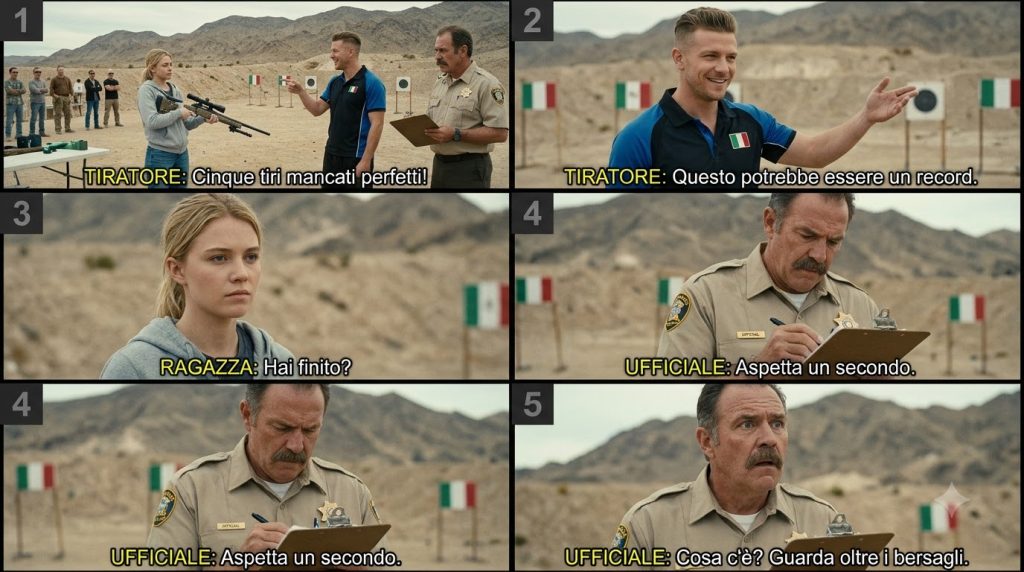
It was the kind of answer her father would have given.
She smiled at the thought.
Then she turned toward the stands.
For the first time in a long while, the sight of the firing line did not make her think about the day everyone laughed.
She thought about what had changed afterward.
Not perfectly.
Not completely.
But enough to matter.
***
At the end of the championship, Claire visited the small memorial display dedicated to Daniel Bennett.
The plaque was simple.
It listed his name, his contribution to technical validation, and the principle that had guided his work.
VERIFY THE RECORD.
Beneath it, a smaller inscription read:
Integrity begins when evidence is allowed to challenge authority.
Claire touched the edge of the plaque.
The metal was warm from the afternoon sun.
She closed her eyes.
For years, she had wanted her father to be vindicated so completely that nobody could ever question him again.
Now she understood that no report could guarantee that.
Someone would always be free to misunderstand.
Someone would always be free to doubt.
What mattered was whether the evidence could be examined, whether mistakes could be corrected, and whether people with power were willing to accept consequences when they failed.
She opened her eyes.
A group of young competitors stood nearby, reading the inscription.
One of them turned toward her.
“Was he really the engineer who helped design the original validation system?”
Claire nodded.
“Yes.”
The young competitor looked at the plaque again.
“That’s incredible.”
Claire smiled.
“He would have said he was just doing his job.”
The young man laughed.
“Sounds like my grandfather.”
For a moment, Claire felt the familiar ache of missing someone.
But it no longer swallowed everything around it.
She could miss her father and still enjoy the sunlight.
She could remember what had happened without allowing the worst day of her life to define every day that followed.
She could forgive herself for not being able to save him.
And she could carry his work forward without carrying every ounce of his pain.
The young competitor thanked her and returned to his friends.
Claire remained beside the plaque for another minute.
Then she walked toward the exit.
***
That evening, Nathan received a letter.
It arrived at his home in a plain envelope with no return address.
He recognized Claire’s handwriting from the evidence forms she had submitted during the investigation.
He opened it carefully.
The letter was short.
Chief Cole,
I read the supplemental report.
I still wish you had helped my father when he asked.
I wish you had looked at the evidence before it became impossible to ignore.
I don’t know whether forgiveness is something I can give you now.
Perhaps it is not something I need to decide today.
But I wanted you to know that the new procedures are working.
Yesterday, a test discrepancy was identified, documented, reviewed, and corrected without anyone being punished for reporting it.
That is the kind of system my father wanted.
I thought you should know.
Claire.
Nathan read the letter twice.
Then he sat down at his kitchen table.
He did not mistake it for forgiveness.
She had made that clear.
But it was not a rejection either.
It was a small acknowledgment that the work had continued.
He folded the letter and placed it in a drawer beside his old credentials.
Then he went outside.
The evening sky was pale orange, and the air carried the dry scent of the desert.
He stood on the porch until the light faded.
For the first time since leaving the championship, he felt something other than shame.
Not relief.
Not absolution.
Hope.
The quiet, difficult hope that a person could fail badly, accept the consequences, and still choose to become more honest than he had been before.
He could not repair what had happened to Daniel Bennett.
But he could refuse to pretend that it had never happened.
And he could live the rest of his life remembering why that mattered.
***
One year after the five empty scores, the championship held its opening ceremony beneath a clear Arizona sky.
The crowd was smaller than the year before, but the atmosphere was warmer.
Competitors greeted one another without the same hunger for public spectacle.
Officials explained the verification process before the first event.
The independent technical team published its test results, and the scoring displays remained inactive until the checks were complete.
Claire stood near the back of the stands.
She wore her familiar gray hoodie.
No sponsors.
No expensive equipment.
No recognizable name printed across her chest.
A young woman beside her glanced toward the firing line.
“Were you here last year?”
Claire nodded.
“I was.”
“Was it really as bad as people said?”
Claire considered the question.
“It was bad in ways people didn’t understand.”
The young woman looked at her.
“Did you win?”
Claire smiled faintly.
“That’s a complicated question.”
Before the woman could ask anything else, the opening announcement sounded across the stadium.
The crowd turned toward the range.
Nathan was no longer the chief referee, but he had been invited to attend as a private guest.
He sat several rows ahead, wearing a simple shirt without the championship insignia.
Samuel stood beside the technical enclosure.
Ryan Mercer waited among the competitors.
He was still talented.
Still competitive.
Still capable of feeling the familiar rush when the crowd quieted before a difficult event.
But he no longer looked around to see whether everyone was watching him.
When a young competitor dropped a piece of equipment near the registration area, Ryan helped retrieve it.
When another athlete questioned a procedural detail, he listened instead of making a joke.
He was not a different person overnight.
He still had moments of impatience.
He still disliked criticism.
He still felt the old instinct to defend himself when someone questioned his judgment.
But he had learned to recognize the instinct before obeying it.
That was where his change had begun.